Glossary term
Moving Average
A moving average is a technical-analysis measure that smooths price data over a selected period to help show trend direction and reduce day-to-day noise.
Updated
Read time
What Is a Moving Average?
A moving average is a technical-analysis measure that smooths price data over a selected period to help show trend direction and reduce day-to-day noise. Instead of focusing on every short-term price move, a moving average combines recent observations into a rolling average so the broader direction of the market becomes easier to see.
Moving averages are common in chart analysis because they are simple, flexible, and useful for thinking about trend, momentum, and support or resistance behavior.
Key Takeaways
- A moving average smooths price data across a selected rolling period.
- It is mainly used in technical analysis to identify trend direction and market context.
- Longer periods create smoother but slower signals, while shorter periods react faster but produce more noise.
- Moving averages can be useful for framing trend, but they do not predict the future with certainty.
- They are often discussed together with momentum, support, resistance, and volatility.
How a Moving Average Works
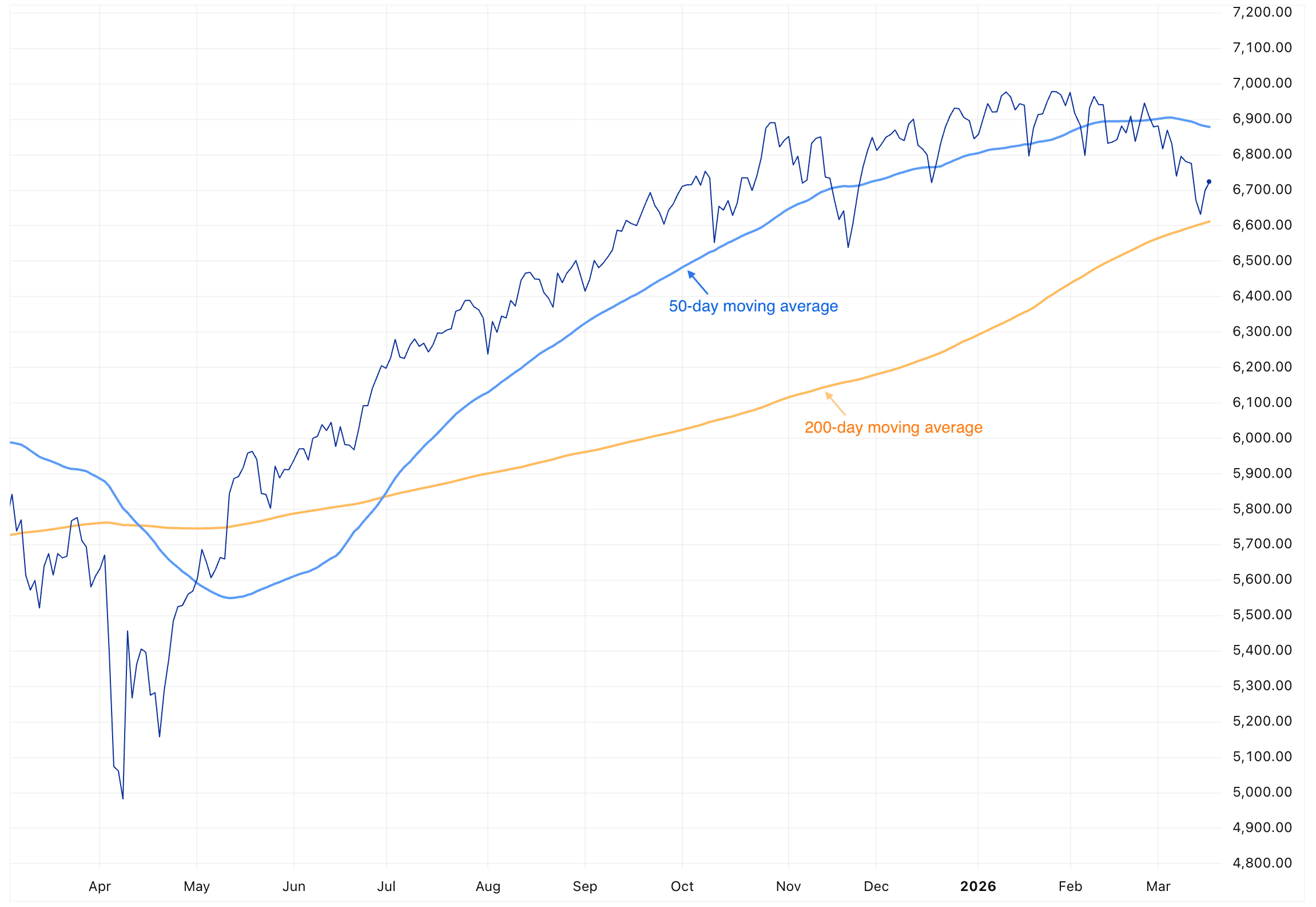
A moving average takes a series of prices and averages them over a chosen period, such as 10 days, 50 days, or 200 days. As new price data comes in, the oldest observation drops off and the newest one is added. That rolling process creates a smoothed line that updates over time.
At a basic level, the idea can be expressed like this:
Moving average = sum of selected period prices / number of periods
There are different versions, including simple moving averages and exponential moving averages, but the core purpose is the same: reduce noise so the underlying trend is easier to interpret.
Why Moving Averages Matter Financially
Moving averages matter because entry, exit, and risk-control decisions are often affected by how traders interpret trend. A choppy market can be hard to read from raw price action alone. A moving average helps show whether recent prices are generally rising, falling, or flattening.
For many investors, the value is not that the indicator is magical. The value is that it imposes a consistent way to read market behavior instead of reacting emotionally to every price move.
Shorter Versus Longer Moving Averages
Average length | Typical effect |
|---|---|
Shorter period | Responds faster but can produce more false signals |
Longer period | Responds more slowly but filters more noise |
This tradeoff is why traders may use more than one moving average at the same time. A short average can show recent direction, while a longer average can show the broader trend.
How Traders Use Moving Averages
Traders often use moving averages to judge whether price is trading above or below trend, whether momentum is strengthening or weakening, and whether a crossover between averages signals changing market behavior. Some use them as a rough guide for support and resistance. Others use them mainly as a filter to avoid trading against the dominant trend.
Even investors who do not trade actively may still encounter moving averages in market commentary, especially when coverage refers to the 50-day or 200-day moving average.
Limits of Moving Averages
Moving averages are backward-looking because they are built from past prices. That means they can lag sharp market turns and can also produce misleading signals in choppy or sideways markets. A moving average can help organize information, but it does not remove uncertainty or replace broader market judgment.
This is one reason moving averages are best used as part of a framework rather than as a stand-alone decision rule.
Example of a Moving Average in Practice
Suppose a stock has been rising for several months and remains above its 200-day moving average. A trader may interpret that as evidence the longer-term trend is still constructive. If the stock then breaks below that moving average on heavy selling, the same trader may treat it as a sign that market behavior is changing. The moving average did not cause the change. It simply made the shift easier to see in a structured way.
The Bottom Line
A moving average is a rolling price average used to smooth short-term noise and highlight trend direction. It matters because it gives traders and investors a simple way to organize market data, understand trend behavior, and reduce purely emotional reactions to everyday price movement.